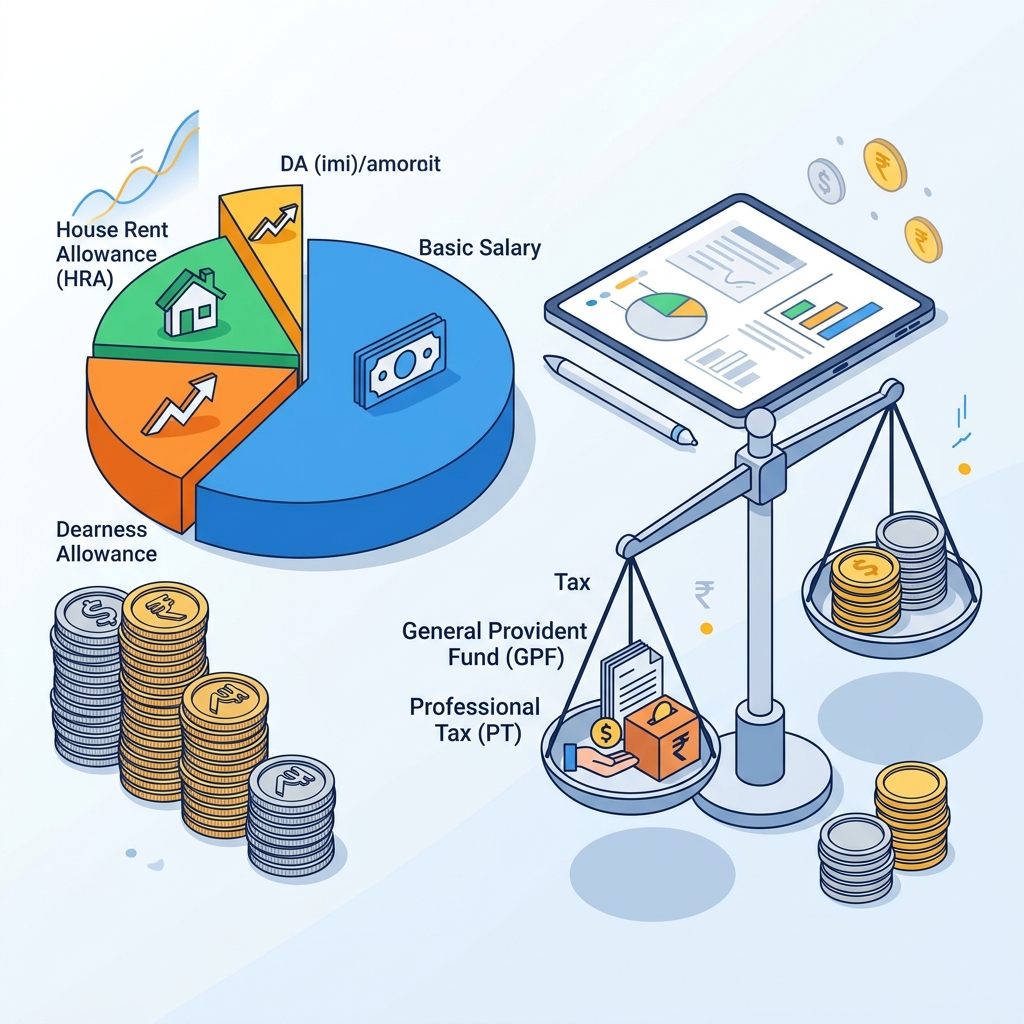
Navigating public sector payroll structures can be complex due to the combination of multiple allowance components and mandatory statutory deductions. For West Bengal government employees, salary packages are governed strictly by the Revision of Pay and Allowances (ROPA) rules. Understanding the difference between Gross Salary and Net Take-Home Salary is vital for financial planning, loan applications, and tax filing. This comprehensive guide details the mathematical equations used to compute salary components, Professional Tax (P-Tax) slab brackets, and the guidelines governing pension deductions.
Step-by-Step Derivation of Gross Salary
Gross Salary is the total earnings an employee receives in a month before any statutory or voluntary deductions are applied. It is calculated by adding multiple components to the core Basic Pay. The standard mathematical equation is:
Gross Salary = Basic Pay + Dearness Allowance + House Rent Allowance + Medical Allowance + Special Allowances
Each component is defined as follows:
- Basic Pay: The core pay scale determined by your level and cell position in the ROPA 2019 Pay Matrix. It increases by approximately 3% annually through regular increments.
- Dearness Allowance (DA): The cost-of-living adjustment allowance, calculated as a percentage of Basic Pay. The rate varies depending on budgetary announcements.
- House Rent Allowance (HRA): Compensation for rental housing. Under ROPA rules, this is usually 12% of Basic Pay, subject to a designated upper ceiling limit (e.g., ₹ 12,000 per month).
- Medical Allowance: A fixed monthly payout, currently set at ₹ 500 under ROPA 2019, to help cover basic outpatient medical needs.
Statutory and Voluntary Deductions
To arrive at the Net Take-Home Salary, several deductions are subtracted from your Gross Salary. These are categorized into:
- General Provident Fund (GPF) or NPS: For employees hired before 2004, a minimum of 6% of basic pay is deducted for GPF savings. For employees under the National Pension System (NPS), a mandatory 10% of (Basic Pay + DA) is deducted.
- Professional Tax (P-Tax): A state-imposed tax on professions, trades, and employments, deducted in accordance with designated monthly gross income slabs.
- Group Insurance Scheme (GISS): A small monthly contribution towards a group life insurance policy, providing a lump-sum payout upon retirement or death.
- Income Tax TDS: Tax Deducted at Source, computed by the DDO based on your estimated annual income and declared tax regime.
West Bengal Professional Tax (P-Tax) Slabs
The state government implements a progressive Professional Tax structure. The deduction is applied directly based on your monthly gross salary bracket:
| Monthly Gross Income Bracket |
Monthly P-Tax Deduction (₹) |
| Up to ₹ 10,000 |
NIL (₹ ) |
| ₹ 10,001 to ₹ 15,000 |
₹ 110 per month |
| ₹ 15,001 to ₹ 25,000 |
₹ 130 per month |
| ₹ 25,001 to ₹ 40,000 |
₹ 150 per month |
| Above ₹ 40,000 |
₹ 200 per month |
Frequently Asked Questions (FAQs)
Q1: What are the current rules for HRA in West Bengal?
House Rent Allowance (HRA) is calculated as a percentage of your Basic Pay. Under the current ROPA 2019 rules, most departments offer HRA at 12% of Basic Pay, subject to a maximum cap of ₹ 12,000 per month. Specific branches may offer different rates (e.g., 16% up to ₹ 16,000), depending on their administrative circle.
Q2: What is the standard Medical Allowance rate?
The standard monthly Medical Allowance for active state government employees under ROPA 2019 is fixed at **₹ 500 per month**. However, employees who opt for the West Bengal Health Scheme (WBHS) or government health insurance cards are not eligible for this cash allowance.
Q3: How does GPF deduction work?
The General Provident Fund (GPF) deduction requires a minimum monthly contribution of 6% of the employee's Basic Pay. There is no maximum limit, allowing employees to voluntarily increase their contributions to lower their tax liability under the Old Tax Regime, though changes are subject to annual administrative schedules.
Q4: Is Professional Tax (P-Tax) deductible under Section 16 of the Income Tax Act?
Yes. Under Section 16(iii) of the Income Tax Act, 1961, any Professional Tax paid to the state government is fully deductible from your Gross Salary when calculating taxable income. This deduction is allowed under the Old Tax Regime, reducing your net tax liability.
Q5: What is the difference between GPF and NPS deductions?
GPF is a defined-benefit savings account for older employees, where interest rates are set quarterly by the government. NPS is a market-linked contribution account for newer employees (hired post-2004), where contributions are split between the employee (10% of basic + DA) and a matching state government contribution, invested in pension fund portfolios.
Q6: How does extraordinary leave (EOL) affect my salary and deductions?
Extraordinary Leave without pay results in a direct reduction of your basic pay for the days you are absent. Consequently, your gross salary, DA, and HRA components are reduced proportionally. Mandatory deductions like NPS or GPF are also recalculated based on the lower basic pay earned during that month.